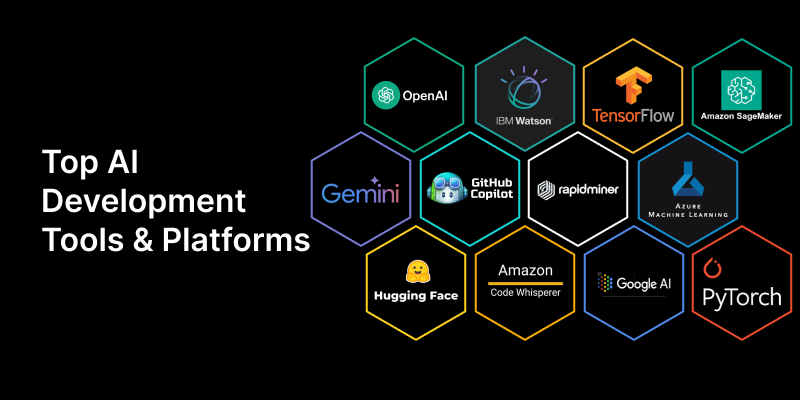
AI Tools for Developers
1. What is GitHub Copilot?
A coding assistant that suggests whole lines or blocks of code as you type. It’s like an autocomplete on steroids.
It understands context from comments and function names to generate relevant code.
Example: Type // function to calculate average and it writes the function body for you.
2. What is ChatGPT?
A conversational AI that can answer questions, write code, explain concepts, and even debug your errors. It acts like a pair programmer, helping you brainstorm logic or convert code from one language to another. Example: Paste a Python script and ask, “Convert this to JavaScript,” and it generates the JS version.
3. What is Hugging Face?
A platform (like GitHub for AI) where developers share pre-trained models and datasets, making it easy to use advanced AI without building from scratch. It hosts thousands of models for tasks like text classification, audio processing, and image generation. Example: You can download a “sentiment analysis” model with just two lines of Python code to check if a review is positive or negative.
4. What is the OpenAI API?
A service that allows developers to integrate powerful models like GPT-4 and DALL-E directly into their own applications using code. It enables features like chatbots, summarization, and content generation inside your apps. Example: You can send a user’s prompt to the API endpoint and get a text response to display in your chat app.
5. What is Google Gemini?
A family of powerful AI models from Google that can understand text, code, images, and video. Developers use it for coding assistance (Gemini Code Assist) and building multimodal apps. It excels at reasoning and can handle complex tasks involving different types of input simultaneously. Example: You can upload a diagram of a database schema and ask Gemini to write the SQL code to create those tables.
6. What is Claude?
An AI model by Anthropic known for its massive “context window,” meaning it can read and analyze huge amounts of code or documentation at once. It is designed to be helpful, harmless, and honest, often producing safer and more reliable outputs. Example: You can paste an entire 50-page technical manual and ask Claude to “Summarize the installation steps.”
7. What is Amazon Q Developer?
An AI assistant from AWS (formerly CodeWhisperer) that helps you write code, debug, and upgrade applications, with a special focus on AWS cloud services. It is deeply integrated with the AWS ecosystem, offering suggestions based on best practices for security and performance. Example: While writing a Lambda function in your IDE, it suggests the correct code to connect to an S3 bucket securely.
8. What is Tabnine?
An AI code completion tool that learns from your specific coding style. It is popular because it can run privately on your own computer or server for security.
Unlike cloud-only tools, it can run locally, ensuring your proprietary code never leaves your machine.
Example: As you define a variable userList, it predicts you’ll want to write a loop to iterate through it based on your previous coding patterns.
9. What is LangChain?
A framework that helps you build apps using LLMs (like GPT). It connects the AI to other tools (like Google Search or your own database) so it can do more than just chat. It allows you to create “chains” of commands, where the output of one step becomes the input of the next. Example: Chain 1: “Translate this email to English.” Chain 2: “Summarize the English email.” The AI does both in sequence automatically.
10. What is AutoGPT?
An autonomous AI agent that uses GPT-4 to achieve a goal. You give it a task (like “create a website”), and it breaks it down into steps and executes them by itself without needing you to type every prompt.
It can browse the internet, search for information, and save files to your computer to complete its mission.
Example: Task: “Find the top 5 pizza places in New York and save them to a file.” AutoGPT searches Google, compiles the list, and creates a pizza.txt file.
11. What is LlamaIndex?
A data framework for connecting custom data sources (like PDFs, Notion, or SQL databases) to Large Language Models (LLMs), making it easier to build search and QA applications. It organizes your private data into a format that LLMs can easily understand and query. Example: You can feed it your company’s internal HR handbook (PDF) and then build a chatbot that answers employee questions like “What is the holiday policy?”
12. What is Midjourney?
An AI tool used to generate high-quality images from text descriptions. Developers use it to create assets, icons, or design mockups for their applications. It runs on Discord and uses advanced artistic styles to create visuals that look like photos or paintings. Example: Prompt: “A futuristic dashboard UI for a banking app, blue and white theme.” Midjourney generates 4 unique design concepts you can use for inspiration.
13. What is Replit AI?
An AI coding assistant built into the Replit online IDE. It helps you write, debug, and explain code directly in the browser. It is aware of your entire project file structure, making its suggestions contextually accurate for your specific app. Example: Highlight a block of confusing code and click “Explain,” and Replit AI describes exactly what that logic does in plain English.
14. What is Cursor?
An AI-first code editor built on VS Code. It lets you chat with your codebase, generate code from natural language, and edit existing code using AI commands.
It indexes your entire project, so it understands how different files connect when answering questions.
Example: Select a function and press Cmd+K, then type “Refactor this to use async/await,” and Cursor applies the changes directly.
15. What is Codeium?
A free AI-powered coding toolkit similar to GitHub Copilot. It offers autocomplete, chat, and search capabilities for many IDEs. It is popular for its generous free tier for individuals and support for a wide range of editors like Vim and JetBrains. Example: As you type a complex SQL query, Codeium suggests the complete join statement based on your table schema.
16. What is Warp?
A modern terminal that uses AI to help you write shell commands. You can describe what you want to do in English, and it generates the command.
It turns the command line into a collaborative, text-editor-like experience with blocks instead of a continuous stream of text.
Example: Type “undo the last git commit” in the AI input, and Warp suggests git reset --soft HEAD~1.
17. What is Phind?
An AI search engine specifically designed for developers. It provides answers to coding questions with code snippets and links to sources (like StackOverflow or documentation).
Unlike general chatbots, it is optimized for technical accuracy and current library versions.
Example: Search “How to center a div in Tailwind CSS,” and Phind gives you the exact class names (flex justify-center items-center) with an explanation.
18. What is Postbot (Postman AI)?
An AI assistant within Postman that helps you design, test, and document APIs. It can automatically generate test cases for your endpoints or write documentation based on the request structure. Example: Click “Add Tests” and ask Postbot to “Check if response time is under 200ms,” and it writes the JavaScript test code for you.
19. What is Snyk DeepCode?
An AI-powered security tool that scans your code for vulnerabilities and bugs in real-time. It uses machine learning trained on open-source projects to find security flaws that static analysis might miss. Example: It highlights a line of code vulnerable to SQL injection and suggests a secure parameterized query fix.
20. What is Ollama?
A tool that allows developers to run powerful LLMs (like Llama 2 or Mistral) locally on their own machines.
It simplifies the setup process, allowing you to use AI without sending data to the cloud.
Example: Run ollama run llama2 in your terminal to start chatting with the Llama 2 model offline.
21. What is Devin (by Cognition)?
An autonomous AI software engineer that can plan, execute, and debug complex engineering tasks. Unlike simple assistants, it has its own shell, code editor, and browser to function like a human developer. Example: Give it a GitHub issue link, and Devin will clone the repo, reproduce the bug, fix it, and create a pull request.
22. What is V0 (by Vercel)?
A generative UI tool that creates production-ready React code (using Tailwind CSS and Shadcn UI) from text prompts. It simplifies frontend development by generating component structures and styles instantly. Example: Prompt: “A pricing page with three tiers and a dark mode toggle,” and V0 generates the full React component code.
23. What is Mistral Codestral?
An open-weight AI model explicitly designed for code generation tasks by Mistral AI. It is optimized for low latency and performance, supporting over 80 programming languages for completion and tests. Example: It can be integrated into IDEs to provide fast, local-first code suggestions without relying on proprietary closed APIs.
24. What is Supermaven?
A code completion tool known for its massive 1-million-token context window and low latency. It allows the AI to “read” your entire codebase simultaneously, providing highly relevant suggestions even for large projects. Example: If you defined a function in a different file thousands of lines ago, Supermaven remembers it and suggests the correct usage instantly.
25. What is GitHub Copilot Workspace?
A task-centric development environment that helps developers brainstorm, plan, and implement code changes from issues. It bridges the gap between an issue description and code by generating a step-by-step plan and editing multiple files at once. Example: Open an issue, click “Open in Workspace,” and the AI proposes a plan to fix the issue, which you can refine before code generation.
26. What is Perplexity AI?
A conversational search engine that provides concise answers with citations. Developers use it to research errors, libraries, or documentation without clicking through multiple links. It combines GPT-4/Claude capabilities with real-time web search for up-to-date technical info. Example: Ask “How do I fix a CORS error in Next.js 14?” and it gives the exact solution with links to recent GitHub discussions.
27. What is Sourcegraph Cody?
An AI coding assistant that uses “code graph” technology to understand your entire codebase deeply. It retrieves context from across all your repositories, not just the open file, to answer complex architectural questions. Example: Ask “Where is the authentication logic handled in our mono-repo?” and Cody points to the specific files and functions.
28. What is CodiumAI (Qodo)?
An AI tool specifically designed to generate meaningful software tests (unit tests, integration tests). It analyzes your code logic and suggests edge cases you might have missed to ensure code integrity. Example: It scans a function and automatically generates a test suite covering null inputs, negative numbers, and boundary conditions.
29. What is Blackbox AI?
A coding assistant known for its ability to extract code from videos and images. It allows developers to copy code from tutorials or screenshots instantly and also provides autocomplete features. Example: Take a screenshot of a coding tutorial video, and Blackbox converts the visual text into executable code in your editor.
30. What is Open Interpreter?
An open-source tool that lets LLMs run code (Python, JavaScript, Shell) locally on your computer. It acts like an open-source version of ChatGPT’s Code Interpreter, capable of controlling your OS to perform tasks. Example: Command: “Convert all PNG files on my desktop to JPG,” and it writes and runs a Python script to do it immediately.
31. What is CodeRabbit?
An AI-powered code review tool that integrates with GitHub/GitLab. It analyzes pull requests and provides line-by-line feedback, summary, and bug detection. It acts like an automated senior developer reviewing your PRs instantly. Example: Open a PR, and CodeRabbit comments on a logic error in your loop and suggests a more efficient implementation.
32. What is Mintlify?
An AI tool that automates code documentation. It reads your code and generates comprehensive, beautiful documentation websites. It scans your repository and creates explanations for functions, API endpoints, and usage guides. Example: Highlight a function in VS Code, click “Write Docs,” and Mintlify generates a JSDoc/docstring explaining parameters and return values.
33. What is Pieces for Developers?
An AI-enabled snippet manager that saves, generates, and enriches code snippets. It helps developers manage their “micro-knowledge.” It uses on-device AI to tag, title, and explain saved snippets automatically. Example: Copy a complex RegEx pattern, save it to Pieces, and it automatically adds a title like “Email Validation Regex” and explains how it works.
34. What is Mutable.ai?
An AI tool that turns your codebase into a Wikipedia-style article. It generates high-level documentation and diagrams to help new developers understand the project. It automatically updates the documentation as the code changes. Example: A new hire asks “How does the payment flow work?”, and Mutable.ai provides a summarized article with links to relevant code files.
35. What is Grit.io?
An automated developer tool for code migrations and technical debt cleanup. It uses AI to handle massive refactoring tasks. It is more powerful than simple find-and-replace, understanding syntax trees to migrate frameworks or patterns. Example: You want to convert an entire project from JavaScript to TypeScript or from Angular to React; Grit.io automates the bulk of the syntax translation.
36. What is Aider?
A command-line tool that lets you pair program with LLMs to edit code in your local git repository.
It works with existing files and can commit changes automatically with sensible messages.
Example: Run aider in your terminal, ask it to “Add a dark mode toggle to the navbar,” and it edits the CSS and JS files directly.
37. What is Project IDX (Google IDX)?
A browser-based development environment (IDE) built by Google that integrates AI assistance (Gemini) directly into the workflow. It provides full-stack web and multiplatform app templates with built-in emulators (Android/iOS) in the cloud. Example: You can start a Next.js project in your browser, and use the AI sidebar to debug the code running in the preview window.
38. What is MetaGPT?
A multi-agent framework that assigns different roles (Product Manager, Architect, Engineer) to GPT models to build software. It takes a one-line requirement and generates user stories, competitive analysis, data structures, and APIs. Example: Input: “Create a snake game,” and MetaGPT simulates a team of developers to write the design document and the code.
39. What is Sweep AI?
An AI junior developer that handles GitHub issues. It reads the issue description, plans the changes, writes the code, and creates a pull request. It is designed to handle small bugs and feature requests autonomously. Example: Tag a GitHub issue with “Sweep,” and it automatically comments with a plan and opens a PR with the fix.
40. What is GPT Engineer?
An open-source tool that generates an entire codebase from a single prompt. It asks clarifying questions to understand what you want to build before writing the code. It focuses on generating “easy to adapt” code rather than just snippets. Example: Prompt: “Build a pomodoro timer app with React,” and it asks “Should it have sound?” before generating the project files.
41. What is DeepSeek Coder?
An open-source code generation model that is highly performant and supports project-level code completion. It is trained on a massive dataset of code and is known for its ability to handle long contexts. Example: Developers can self-host DeepSeek Coder to build a private coding assistant that understands their entire repository.
42. What is Code Llama (Meta)?
A family of large language models for code released by Meta, built on top of Llama 2.
It includes base models, Python-specialized models, and instruct models for chatting about code.
Example: You can run codellama:7b locally using Ollama to generate unit tests without internet access.
43. What is StarCoder (BigCode)?
An open-access Large Language Model for Code (LLMC) developed by the BigCode community (ServiceNow & Hugging Face). It is trained on permissible data (no GPL code) and allows developers to opt-out their code from training data. Example: Use StarCoder via the Hugging Face API to autocomplete Python functions with a focus on avoiding copyright issues.
44. What is What The Diff?
An AI tool that integrates with GitHub to automatically write pull request descriptions and review code. It analyzes the changes in a PR and generates a summary for non-technical stakeholders or teammates. Example: Open a PR with 20 changed files, and What The Diff comments with a structured summary of “What changed” and “Why.”
45. What is Jam.dev?
A bug reporting tool that uses AI to help developers debug web applications faster. It records the screen, console logs, and network requests, and uses AI to explain the error and suggest fixes. Example: A tester finds a bug, clicks the Jam extension, and sends a link to the dev. The dev sees the AI analysis: “The API returned 500 because the payload was missing ‘id’.”
46. What is Continue?
An open-source AI coding assistant that sits inside VS Code or JetBrains. It allows you to connect any LLM (like GPT-4, Claude, or local models via Ollama) to your IDE. It gives you full control over the AI stack you use while coding, unlike proprietary tools that lock you into one model. Example: You can configure Continue to use a secure, local Llama 3 model for sensitive code and GPT-4 for general logic.
47. What is Ellipsis?
An AI developer tool that automates code reviews and bug fixes. It comments on pull requests with specific suggestions and can even commit fixes directly. It acts like an extra team member that handles the mundane parts of code review and maintenance. Example: You open a PR, and Ellipsis comments: “This variable is unused,” and offers a button to remove it automatically.
48. What is Stepsize AI?
An AI tool that tracks engineering activity across Jira, Linear, and GitHub to generate automatic sprint reports. It connects the dots between code changes and project management tickets to explain what happened and why. Example: Instead of spending an hour writing a weekly report, Stepsize AI generates a summary of all merged PRs and completed tickets for you.
49. What is Augment?
A code completion tool designed for extreme speed and deep codebase understanding. It claims to be faster than Copilot. It focuses on “instant” suggestions that feel like they are reading your mind by analyzing your entire project context in real-time. Example: As you start typing a function that relies on a utility defined in a different module, Augment suggests the correct import and usage instantly.
50. What is Unblocked?
An AI knowledge platform for engineering teams. It indexes Slack, Notion, GitHub, and Jira to answer questions like “Why did we build this feature this way?” It prevents developers from having to tap colleagues on the shoulder for historical context. Example: Ask “Who worked on the billing API last year?” and Unblocked identifies the developer and links to the relevant PRs and Slack discussions.
51. What is FigJam AI?
An AI-powered whiteboarding tool from Figma that helps developers brainstorm, create diagrams (like flowcharts or architecture diagrams), and summarize notes automatically. It helps turn unstructured ideas into organized plans. Example: Type “Create a user authentication flow diagram,” and FigJam AI generates the flowchart with login, registration, and password reset steps.
52. What is Bloop?
An AI-powered code search engine that uses natural language to find code across local and remote repositories. It understands the intent behind your search, making it easier to find relevant functions or code examples. Example: Instead of searching for a specific function name, you can ask, “How do we handle user payments in the backend?” and it finds the relevant code.
53. What is CodeWhisperer for command line?
An AI companion for the terminal from AWS that provides code completions and natural language-to-bash translation.
It helps you find the right command without having to remember complex syntax or search online.
Example: Type cw ai translate "find all files larger than 1GB" and it suggests the find . -type f -size +1G command.
54. What is Smol developer (swyx)?
A concept for an autonomous AI agent that can create an entire application from a very detailed prompt. It’s a “scaffolder on steroids” that generates all the necessary files and boilerplate code for a project based on a single specification. Example: You provide a detailed prompt describing a “Todo app with React frontend and Express backend,” and it generates the complete file structure and initial code.
55. What is Cursor’s “Auto-debug” feature?
An AI feature within the Cursor editor that automatically analyzes errors from your terminal, finds the relevant code, and suggests a fix.
It speeds up debugging by connecting the error message directly to the source code and providing a one-click solution.
Example: When your code throws a TypeError, a button appears in the terminal. Clicking it opens the problematic file and shows the AI’s suggested fix.
56. What is GitLab Duo?
An AI-powered suite within GitLab that helps with coding, security, and planning. It includes Code Suggestions and Chat. It integrates directly into the DevSecOps workflow to boost productivity and security. Example: In GitLab, type a comment asking for a vulnerability explanation, and Duo explains the security flaw in your merge request.
57. What is JetBrains AI Assistant?
An AI tool integrated into JetBrains IDEs (IntelliJ, PyCharm, etc.) that understands your project context to provide code completion, refactoring, and explanations. It uses multiple LLMs to provide the best results for the specific task at hand within the familiar IDE interface. Example: Highlight a complex class in IntelliJ IDEA and click “Explain Code” to get a breakdown of its functionality.
58. What is Locofy.ai?
A frontend development tool that converts designs from Figma or Adobe XD into production-ready code (React, Vue, etc.) using AI. It helps bridge the gap between designers and developers by automating the UI coding process. Example: Select a design frame in Figma, run the Locofy plugin, and it generates the responsive React code with Tailwind CSS.
59. What is Bito?
An AI coding assistant that lives in your IDE and CLI. It helps generate code, build unit tests, and explain code using models like GPT-4. It is known for its privacy features and ability to automate repetitive tasks via shortcuts. Example: Right-click a function and select “Generate Unit Tests” from the Bito menu to automatically create a test file.
60. What is AskCodi?
A coding assistant that helps developers write code, documentation, and SQL queries faster. It offers specific “workbooks” for different tasks. It provides a structured way to interact with AI for coding tasks rather than just a chat interface. Example: Use the “SQL Query” workbook in AskCodi to describe a data retrieval need in English, and it generates the complex SQL query.
61. What is Amazon CodeGuru?
A set of developer tools that uses ML to provide intelligent recommendations for improving code quality and identifying expensive lines of code. It has two main components: Reviewer (for static analysis) and Profiler (for runtime performance). Example: It scans your pull request and comments: “This line of code executes a database query inside a loop, which is inefficient.”
62. What is Diffblue Cover?
An AI tool specifically for Java that autonomously writes unit tests. Unlike assistants that suggest code, Diffblue analyzes your codebase and generates compilable, strictly correct JUnit tests automatically. Example: You have a legacy Java class with no tests; Diffblue Cover runs and generates a full suite of regression tests for it in minutes.
63. What is CodeGeex?
An open-source, multilingual code generation model pre-trained on a large code corpus. It is known for its ability to translate code between different programming languages effectively. Example: You select a block of C++ code, and CodeGeex translates it into functionally equivalent Python code.
64. What is MarsCode (by ByteDance)?
An AI-powered IDE and coding assistant that offers features like code completion, generation, and debugging. It is a cloud-based environment that integrates AI deeply into the development workflow. Example: While typing in the cloud IDE, MarsCode predicts the next few lines of logic and offers a one-click fix for syntax errors.
65. What is Salesforce CodeT5?
An open-source Transformer-based model (Unified Pre-trained Encoder-Decoder) designed for code understanding and generation. It excels at tasks like code summarization (explaining what code does) and code refinement. Example: Input a complex function, and CodeT5 generates a concise natural language summary of its purpose for documentation.
66. What is Plandex?
An open-source, terminal-based AI coding engine capable of complex, multi-file tasks. It breaks down large requirements into smaller subtasks and executes them sequentially while managing context to avoid hallucinations. Example: Command: “Build a React component for a login form with validation,” and Plandex creates the component file, the style file, and updates the main app file.
67. What is PolyCoder?
An open-source code generation model trained on multiple programming languages, known for being one of the first open alternatives to Codex. It is particularly strong in C programming languages and serves as a base for research and building custom coding tools. Example: A developer uses a fine-tuned version of PolyCoder to generate C++ code for embedded systems without sending data to external APIs.
68. What is Safurai?
An AI coding assistant extension that helps developers refactor, debug, and document code within their IDE. It emphasizes privacy and offers a “Super Search” to find code snippets and solutions quickly. Example: Highlight a variable name and ask Safurai to “Rename this variable everywhere to be more descriptive,” and it performs the refactoring safely.
69. What is CodePal?
A web-based platform that offers a wide variety of AI coding helpers, from code generation to bug fixing and unit test creation. It acts as a “Swiss Army Knife” for coding tasks that might be tedious to do manually. Example: Paste a piece of minified JavaScript code into CodePal’s “Code Extractor” or “Beautifier” to make it readable and understand its logic.
70. What is Greptile?
An AI tool that indexes entire GitHub repositories to allow developers to ask complex questions about their codebase in plain English. It is designed to help with onboarding and understanding legacy code by searching through the semantic meaning of the code, not just keywords. Example: Ask “How does the authentication middleware interact with the user database?” and Greptile explains the flow with references to specific files.
71. What is Bolt.new (by StackBlitz)?
A browser-based AI development environment that allows you to prompt, run, and edit full-stack web applications instantly. It runs Node.js directly in the browser (WebContainers). It eliminates setup time, letting you go from idea to running app in seconds. Example: Type “Build a blog with Next.js and Tailwind,” and Bolt creates the project, installs dependencies, runs the server, and lets you edit it live.
72. What is Windsurf (by Codeium)?
An “agentic” IDE built by Codeium that focuses on deep context awareness called “Flows.” It allows the AI and developer to work together on the codebase with shared context. It integrates the “Cascade” AI agent that can reason about your entire project state. Example: The “Cascade” feature allows you to describe a complex refactor, and Windsurf navigates multiple files to implement the changes while maintaining context.
73. What is OpenDevin?
An open-source platform for autonomous AI agents that perform software engineering tasks. It is a community-driven, open-source alternative to Devin. It runs in a sandboxed environment where it can execute shell commands, write code, and browse the web. Example: You can run OpenDevin locally using Docker, give it a task like “Fix issue #42 in this repo,” and it will attempt to write code and run tests to solve it.
74. What is Zed AI?
The AI integration within the high-performance Zed code editor. It allows for fast, context-aware chat and code generation, often using models like Claude 3.5 Sonnet. It emphasizes speed and minimal friction, allowing developers to bring files into the AI context easily. Example: In Zed, you can open the Assistant panel, drag in relevant files for context, and ask it to refactor a specific module for better performance.
75. What is Galileo AI?
An AI tool for interface design that generates high-fidelity UI designs from text prompts. It is useful for quickly creating mockups that can be exported to Figma. It helps bridge the gap between an idea and a visual prototype for developers and designers. Example: Prompt: “A settings page for a mobile fitness app with dark mode,” and Galileo generates editable UI designs with layers and components.
76. What is Rift?
An open-source, AI-native IDE that allows developers to build and run their own local AI agents for coding tasks. It focuses on giving developers control over the AI, allowing them to create personalized agents that can read files, execute commands, and edit code. Example: You could create a Rift agent to automatically add logging statements to every new function in your project according to your team’s specific format.
77. What is Devika?
An open-source AI software engineer that aims to be an alternative to Devin. It can take high-level instructions and build entire software projects. It uses a multi-agent system to research, plan, write code, and debug, simulating a human development team. Example: Prompt Devika to “Create a web app that tracks cryptocurrency prices using the CoinGecko API,” and it will plan the project and write the code.
78. What is Builder.io?
A visual development platform that uses AI to help convert designs (like from Figma) into clean, responsive code for frameworks like React or Vue. It allows teams to build web pages with a drag-and-drop interface, which developers can then integrate into their codebase via an API. Example: A marketing team can visually build a new landing page, and developers can render it within their Next.js app without writing the UI code from scratch.
79. What is Applitools?
An AI-powered visual testing platform that automates UI testing by comparing screenshots of an application against a baseline. Its AI can detect meaningful visual bugs (like a broken layout) while ignoring insignificant pixel-level changes. Example: In a CI/CD pipeline, Applitools can automatically flag a pull request if a code change unintentionally breaks the UI on a specific browser.
80. What is Fine.dev?
A platform for creating and deploying autonomous AI agents that can perform complex software development tasks defined in a simple YAML file. It orchestrates LLMs and code interpreters to handle tasks like code generation, refactoring, and dependency management. Example: Define a task for a Fine.dev agent to upgrade all dependencies in a project, run the tests, and attempt to fix any breaking changes it finds.
81. What is FigJam AI?
An AI-powered whiteboarding tool from Figma that helps developers brainstorm, create diagrams (like flowcharts or architecture diagrams), and summarize notes automatically. It helps turn unstructured ideas into organized plans. Example: Type “Create a user authentication flow diagram,” and FigJam AI generates the flowchart with login, registration, and password reset steps.
82. What is Bloop?
An AI-powered code search engine that uses natural language to find code across local and remote repositories. It understands the intent behind your search, making it easier to find relevant functions or code examples. Example: Instead of searching for a specific function name, you can ask, “How do we handle user payments in the backend?” and it finds the relevant code.
83. What is CodeWhisperer for command line?
An AI companion for the terminal from AWS that provides code completions and natural language-to-bash translation.
It helps you find the right command without having to remember complex syntax or search online.
Example: Type cw ai translate "find all files larger than 1GB" and it suggests the find . -type f -size +1G command.
84. What is Smol developer (swyx)?
A concept for an autonomous AI agent that can create an entire application from a very detailed prompt. It’s a “scaffolder on steroids” that generates all the necessary files and boilerplate code for a project based on a single specification. Example: You provide a detailed prompt describing a “Todo app with React frontend and Express backend,” and it generates the complete file structure and initial code.
85. What is Cursor’s “Auto-debug” feature?
An AI feature within the Cursor editor that automatically analyzes errors from your terminal, finds the relevant code, and suggests a fix.
It speeds up debugging by connecting the error message directly to the source code and providing a one-click solution.
Example: When your code throws a TypeError, a button appears in the terminal. Clicking it opens the problematic file and shows the AI’s suggested fix.
86. What is Adrenaline?
An AI-powered debugger that connects to your codebase. You can ask it questions about bugs, and it helps you find the root cause and suggests fixes.
It can analyze stack traces and understand the context of your code to provide relevant debugging help.
Example: You get a NullPointerException. You can ask Adrenaline, “Why is this value null here?” and it will trace the variable’s origin to find the problem.
87. What is Tabby?
An open-source, self-hosted AI coding assistant. It’s an alternative to GitHub Copilot that you can run on your own infrastructure for privacy and customization. It can be fine-tuned on your organization’s codebase to provide more relevant suggestions. Example: A company can deploy Tabby on its own servers, ensuring that its proprietary code is never sent to a third-party cloud service.
88. What is CodeGemma?
A family of lightweight, open-source code models from Google, built on the Gemma architecture. They are designed to run efficiently on a developer’s local machine for tasks like code completion and generation. Example: You can use CodeGemma with a tool like Ollama to get fast code suggestions directly in your IDE without needing a powerful GPU or internet connection.
89. What is Second.dev?
An AI tool that automates large-scale codebase migrations and refactoring, similar to Grit.io. It helps upgrade frameworks, migrate languages, or enforce new coding standards across thousands of files automatically. Example: Use Second.dev to automatically migrate a large Python 2 codebase to Python 3, handling syntax changes and library updates.
90. What is Magic.dev?
An AI software engineer designed to work alongside human developers. It can understand complex requests and perform tasks like implementing features or fixing bugs. It aims to be a collaborative partner rather than just a code completion tool. Example: You can ask Magic.dev to “Implement the user profile page based on the Figma design” and it will generate the necessary components and logic.
91. What is LangSmith?
A platform by LangChain for debugging, testing, evaluating, and monitoring LLM applications. It helps developers move from prototype to production. It provides visibility into the “black box” of LLM chains and agents. Example: You can trace exactly why an LLM chain failed or produced a wrong answer by inspecting the inputs and outputs of every step.
92. What is Vercel AI SDK?
A library for building AI-powered user interfaces in JavaScript/TypeScript frameworks like Next.js. It simplifies streaming responses from LLMs to the frontend.
It provides hooks and utilities to connect to various model providers like OpenAI, Anthropic, and Hugging Face easily.
Example: The useChat hook handles the state of the chat input and messages, streaming the AI response character by character to the UI.
93. What is Lovable?
A generative AI tool that builds full-stack web applications from natural language descriptions. It focuses on creating high-quality, visually appealing software. It integrates with backend services (like Supabase) to create real, functional apps, not just UI mockups. Example: Describe a “Personal finance dashboard with charts,” and Lovable generates the React code, database schema, and connects them.
94. What is Marblism?
A platform that generates a fully functional SaaS boilerplate from a single prompt. It creates the database schema, API endpoints, and frontend pages automatically. It is designed to jumpstart development by handling the repetitive setup of a new web application. Example: Prompt “A platform for walking dogs,” and Marblism scaffolds a project with user authentication, booking tables, and a dashboard.
95. What is Promptfoo?
A CLI tool for testing and evaluating LLM prompts. It helps developers ensure their prompts produce consistent and correct outputs across different models. It allows for regression testing of prompts, ensuring that changes don’t break expected behavior. Example: You can run a test suite to check if your “summarize” prompt works correctly on GPT-4, Claude, and Llama 3 simultaneously.
96. What is Cline?
An open-source autonomous coding agent that lives in your IDE (VS Code). It handles complex software development tasks by executing terminal commands, creating files, and editing code. It gives you full control over the “loop” of the agent, allowing you to approve every step or let it run autonomously. Example: Ask Cline to “Refactor this entire module to use TypeScript interfaces,” and it will iteratively edit files and fix errors until done.
97. What is the Model Context Protocol (MCP)?
An open standard introduced by Anthropic that allows AI assistants (like Claude Desktop or IDEs) to connect to external data and tools safely. It solves the “integrations” problem by providing a universal way for AIs to access local files, databases, or APIs. Example: A developer uses an MCP server to let Claude read their local SQLite database and answer questions about the schema directly in the chat.
98. What is Trae?
An adaptive AI IDE created by ByteDance that integrates AI natively into the coding workflow. It features a “Builder” mode similar to Windsurf’s Flows. It focuses on understanding the user’s intent and context to provide faster and more accurate code generation. Example: You can drag and drop an image of a UI design into Trae, and it will generate the corresponding React code using your project’s existing components.
99. What is LibreChat?
An enhanced, open-source web interface for interacting with various AI models (OpenAI, Anthropic, Mistral, LocalAI). It provides features like conversation branching, plugin support, and artifact rendering that are often missing or paid in official apps. Example: A developer sets up LibreChat on their local server to provide the entire team with a unified, secure interface to access GPT-4 and Claude 3.5.
100. What is Qodo Merge (formerly CodiumAI PR-Agent)?
An AI-powered tool specifically for automating pull request (PR) reviews and management. It integrates with GitHub, GitLab, and Bitbucket. It provides automatic PR descriptions, code suggestions, and security analysis to speed up the review process. Example: When a developer opens a PR, Qodo Merge automatically scans the changes, writes a detailed summary, and tags the relevant reviewers.


Comments